If you drank coffee this morning, there is a fair chance Brazil had something to do with it. Brazil has been the world's largest coffee producer for more than 150 years, growing roughly a third of the global supply. Yet while coffee lovers debate Ethiopian heirlooms and Kenyan auctions, Brazilian coffee often plays the quiet supporting role. Here is why that role matters so much, and why Brazilian beans deserve attention in their own right.
Coffee Regions 7 min read
Brazilian Coffee: How One Country Shapes Every Cup
Brazil grows roughly a third of the world's coffee, yet it rarely gets the spotlight. Here is how one country's harvest quietly shapes almost every blend, and what Brazilian coffee tastes like on its own.
2026-11-06
The Giant of Coffee
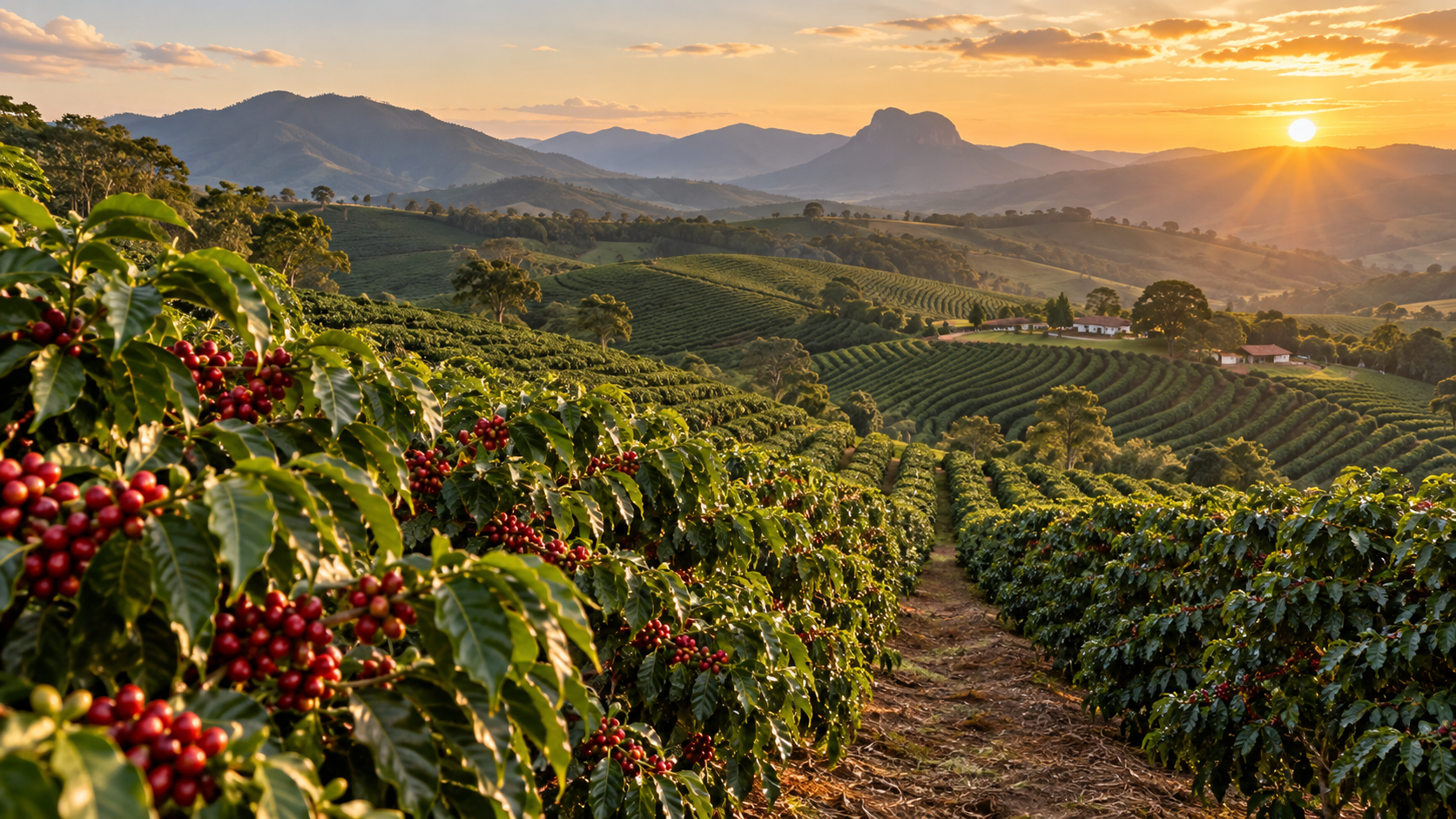
Coffee arrived in Brazil in the 1700s and found a country seemingly built for it: vast highland plateaus, a mild climate, and room to expand. By the 1840s Brazil was the world's leading producer, a position it has never surrendered.
The scale is hard to grasp. Brazil harvests tens of millions of 60-kilogram bags in a good year, more than the next several producers combined. The main growing regions include Minas Gerais, Sao Paulo, and Espirito Santo for arabica, with Rondonia producing much of the country's robusta.
That scale gives Brazil an outsized influence on the entire coffee market. A frost in the Brazilian highlands can move world prices within hours. The famous 1975 frost did exactly that, tripling prices and changing buying habits for a generation.
What Brazilian Coffee Tastes Like
Brazilian coffee is typically the opposite of a bright, fruity Kenya: mild, sweet, and low in acidity, with flavors of chocolate, caramel, nuts, and dried fruit. The body is often full and creamy, which makes Brazilian beans endlessly drinkable and easy to love.
Much of that profile comes from processing. Brazil's relatively dry harvest season allows natural processing, where whole coffee cherries dry in the sun with the fruit intact. The beans absorb sweetness from the drying fruit, deepening those chocolate and dried-fruit notes. Brazil also pioneered pulped natural processing, a middle path that keeps some of the fruit's sweetness while drying cleaner.
Growing altitude in Brazil is modest by specialty standards, usually 800 to 1,300 meters, which contributes to the softer acidity. What Brazil lacks in altitude it makes up for in consistency and sweetness.
Brazil is also a study in variety. Beyond the familiar chocolate-and-nut profile, the country's better estates grow everything from floral Mundo Novo to prized Yellow Bourbon, and the emerging specialty scene in regions like Chapada Diamantina produces cups of surprising elegance. The old image of Brazil as a blender's commodity origin is decades out of date, even if blends still lean on its sweetness.
The Backbone of Espresso
If Brazilian coffee rarely headlines a single-origin menu, it anchors something bigger: espresso blends. Roasters have relied on Brazil for decades to provide the chocolatey base, creamy body, and natural sweetness that make an espresso blend balanced and forgiving.
A classic Italian-style blend might pair Brazilian naturals for sweetness and body with a brighter Central American coffee for lift and a touch of robusta for crema and punch. Even in specialty cafes, Brazil often provides the foundation that lets more flamboyant coffees shine.
Brazilian beans also make an excellent single-origin espresso on their own. A naturally processed Brazil, pulled as a shot, gives you chocolate, hazelnut, and caramel in a cup that is hard to brew badly. For home baristas still dialing in, it is the most forgiving teacher there is.
That reliability has a quiet virtue at home, too. Brazilian coffee forgives inconsistency: a slightly uneven grind, water a few degrees off, a steep that runs long. The cup stays sweet and balanced anyway. For anyone learning a new brewer, a good Brazil is the kindest practice partner on the shelf.
Brewing Brazilian Coffee at Home
Brazil's chocolate-and-nut profile is wonderfully versatile. It makes a rich, sweet French press, a smooth cold brew, and a comforting daily drip coffee. For espresso drinkers, a moka pot brings out its concentrated, chocolatey side; our moka pot guide is at https://ourcoffeetyme.com/article/moka-pot-stovetop-espresso.
Because Brazilian coffee is low in acidity, it pairs beautifully with milk. It is the natural base for homemade lattes, including flavored ones like our peppermint mocha at https://ourcoffeetyme.com/article/peppermint-mocha-at-home. The coffee's sweetness carries the milk rather than fighting it.
Look for bags labeled with a specific region, like Cerrado Mineiro or Sul de Minas, and a recent roast date. Single-estate Brazilian coffees have improved enormously, and the best of them rival any origin for pure drinkability.
And do not overlook it for filter brewing. A naturally processed Brazil in a pour over gives you a clean, cocoa-sweet cup that is calm rather than boring, the kind of coffee that disappears from the mug faster than you intended.
Keep Exploring
Taste the contrast with Kenya's bright, wine-like cups at https://ourcoffeetyme.com/article/kenya-aa-coffee-explained, or Sumatra's earthy depth at https://ourcoffeetyme.com/article/sumatra-coffee-wet-hulled. Wondering what single origin really means? Our explainer is at https://ourcoffeetyme.com/article/what-single-origin-really-means.
Photo: Monica Kaneko from Sao Paulo, Brasil, CC BY-SA 2.0, via Wikimedia Commons